IonSpark
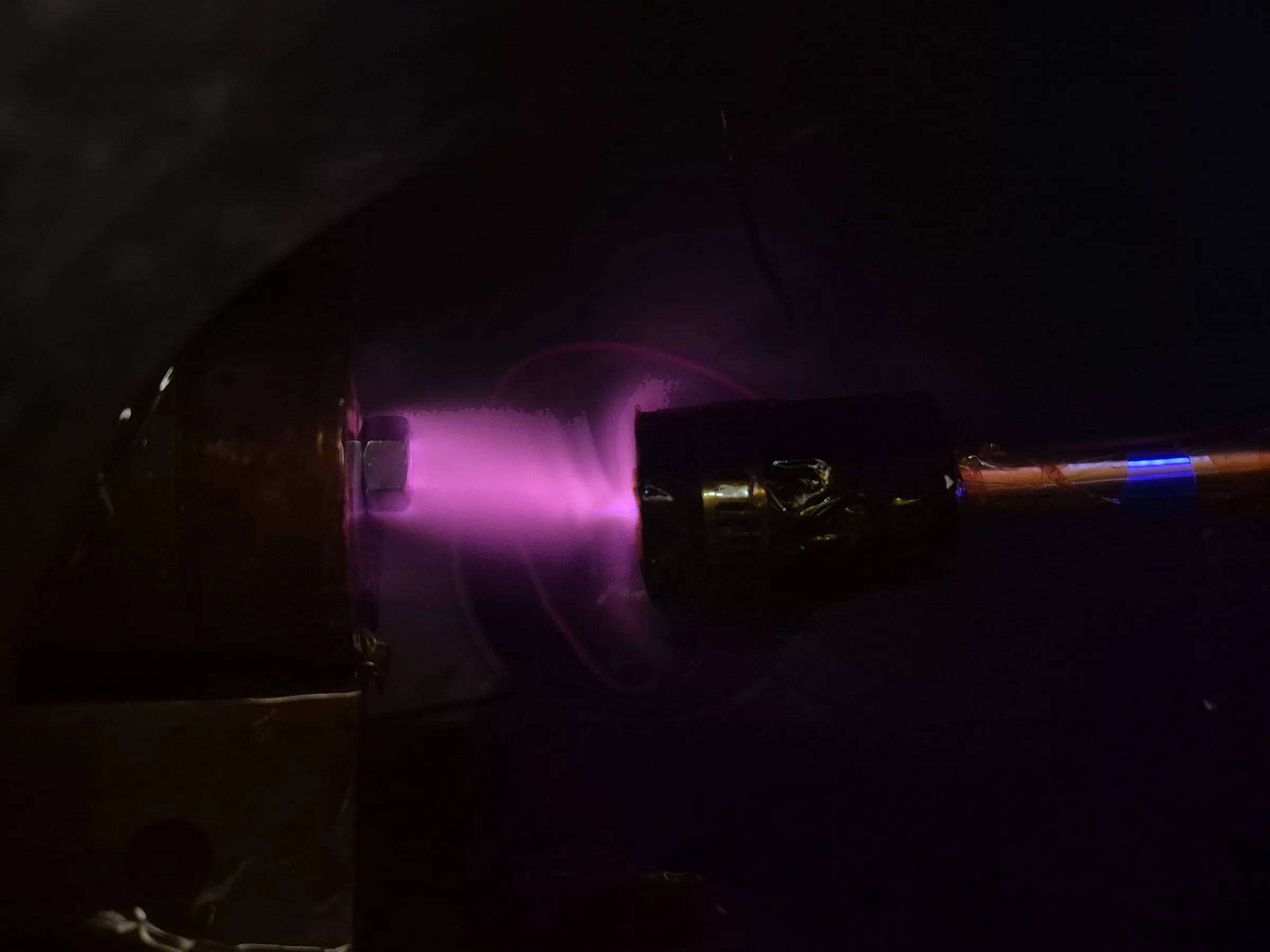 IonSpark operating in vacuum | |
| Type | Heaterless, insertless hollow cathode |
|---|---|
| Based on | Gott & Xu, IEPC-2017-183 |
| Emitter | Tungsten pin |
| Tube | Quartz |
| Working gas | Argon |
| Drive | Pulsed DC or AC, high voltage |
| Reference operating point | 30 W, 3 kV, 150 mA (Gott) |
IonSpark is a heaterless, insertless hollow cathode built by ION-I’s Plasma Source subteam as the electron source for a gridded ion thruster. Its design is adapted from the microplasma heaterless cathode developed by Ryan Gott and Kunning Xu at the University of Alabama in Huntsville.12
Conventional hollow cathodes use a heater and a low-work-function insert to start emitting electrons, which costs power and requires specialty materials that are hard to manufacture. A heaterless, insertless design avoids both.3
Design
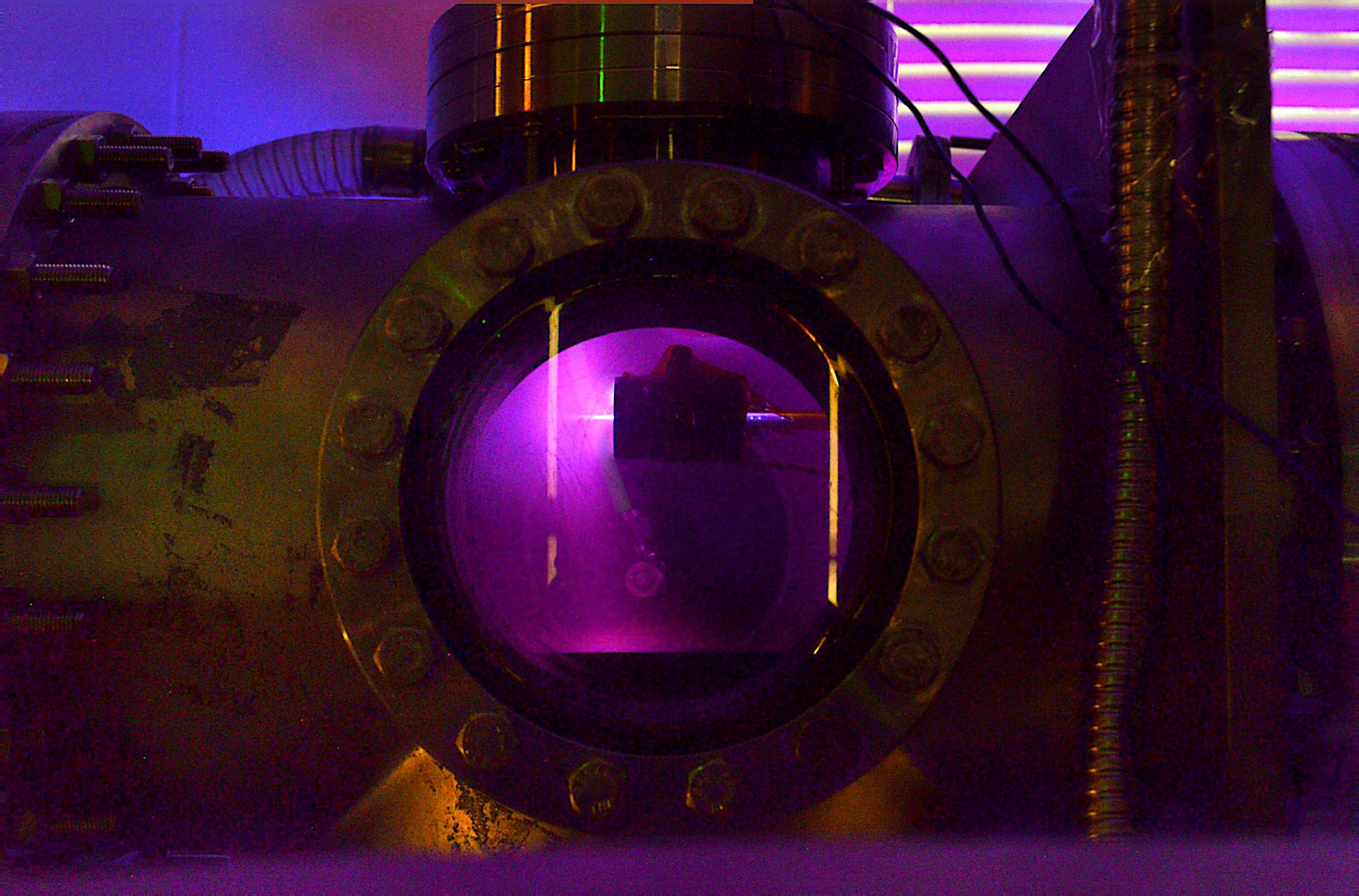
The cathode consists of a tungsten pin inside a quartz tube, with a steel collar around the outside of the tube and a brass ion collector at its end.4
- The tungsten pin is connected to a high-voltage supply and emits electrons by field emission. The electric field at the pin is strong enough that electrons tunnel out of the metal, as described by the Murphy–Good equation.3
- Argon flows through the tube as the working gas. It is first ionized by electrons from the pin; after ignition, stepwise ionization becomes the main source of electrons for the plasma.
- The grounded collar accelerates electrons and controls the plasma plume.
- The ion collector, held at a low voltage, collects argon ions, while electrons are pushed through it and accelerated toward the anode.
The high-voltage source is pulsed DC or AC to prevent charge build-up and arcing. Gott reports optimal efficiency at about 30 W input at 3 kV, producing a 150 mA current after ignition.4
The whole assembly is operated inside a vacuum chamber, so that argon is the only source of ions and the plasma can be measured before it dissipates. A Faraday cage around the chamber shields measurements from external electromagnetic interference.4
Materials
| Part | Material | Reason |
|---|---|---|
| Emitter | Tungsten | Refractory metal with a very high melting point, although its work function is high |
| Tube | Quartz | Inert, high melting point |
| Collar, ion collector | Steel, brass | Good conductors, inexpensive |
| Working gas | Argon | Stable and easily ionized |
Testing
Emitter material study
In spring 2026 the subteam compared pins of tungsten, copper, and aluminum by the electron current each produced. Current was collected by a Faraday cup connected to an ammeter (1 mV per mA) read on an oscilloscope, with chamber pressure held between 3.5 and 4.0 Torr. Each metal was tested five times.3
| Metal | Mean current (mA) | Standard deviation (mA) |
|---|---|---|
| Tungsten | −6.391 | 0.788 |
| Copper | −6.372 | 1.244 |
| Aluminum | −3.891 | 0.584 |
Tungsten produced slightly more current than copper, consistent with the two metals’ similar work functions. Aluminum produced much less current despite having the lowest work function of the three; the authors attribute this to an insulating layer of aluminum oxide that forms almost immediately on contact with air. They also note that residual nitrogen in the chamber was likely being ionized, which inflates the absolute currents but not the comparison between pins.3
See also
References
-
Gott, R. P., The Development and Analysis of a Heaterless, Insertless, Microplasma-Based Hollow Cathode, M.S.E. thesis, University of Alabama in Huntsville, 2017. ↩
-
Gott, R. P., and Xu, K. G., IEPC-2017-183, International Electric Propulsion Conference, 2017. ↩
-
Arunachalam, A., et al., “Material Effects on Electron Emission in a Hollow Cathode”, research poster, ION-I, 2026. ↩ ↩2 ↩3 ↩4
-
ION-I Plasma Source subteam, Systems Requirement Review / Systems Definition Review. ↩ ↩2 ↩3